



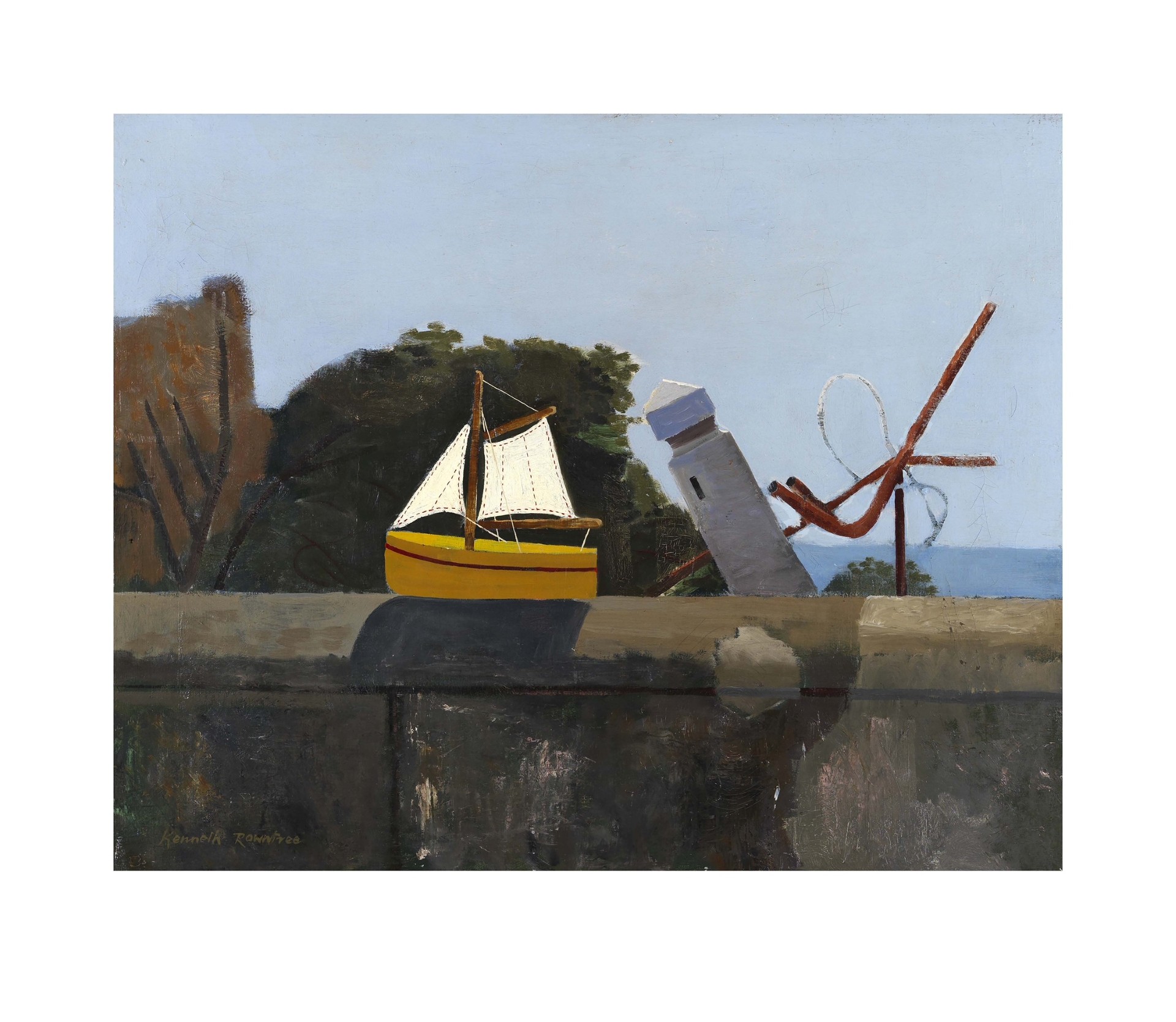
Rowntree, Kenneth – Toy Boat at Selsey
Price range: £195.00 through £333.00
Description
Rowntree painted many boats in his life. He illustrated an article his wife Diana wrote for the Architectural Review on Oxford college barges (used as clubhouses from which to watch the rowing). But here, as elsewhere in his work, we have a child’s boat: bright yellow, with white sails, and stitching very carefully depicted. It is arbitrarily placed atop a concrete wall. But the benign blue of the sky suggests play suspended, and the sun betokens more play to come.

About This Artist
Kenneth Rowntree
Kenneth Rowntree, artist and teacher, was born in Scarborough, Yorkshire. His parents, Howard and Nora Rowntree, were Quakers. His father managed the family department store where Kenneth would display his early works. His mother was musical, she trained as a violinist at the Royal College of Music, and Rowntree, who had taken up the cello, first thought of music as a career, before deciding upon art.
Rowntree attended Bootham Quaker School in York, before enrolling at the Ruskin School of Art, Oxford. Here he met student of architecture, Diana Buckley. They married just as war against Germany was being declared. But by then they had moved to London – Diana to study at the Architectural Association’s School of Architecture, and Rowntree to study at the Slade School of Fine Art. At the Slade Rowntree met Eric Ravilious and Edward Bawden (see Artists), and soon after, these new friends invited the Rowntree’s to Great Bardfield, Essex. Here they made their base, first next door to Edward and Charlotte Bawden, but soon at Simpkin’s Cottage, a short way out of town in the village of Lindsell (see ‘Water Butt, Simpkin’s Cottage’). They had two children, Adam, born 1942, and Sasha, born 1947, but from here they also travelled – to Sweden, the States, Australia, and France.
During the Second World War, Rowntree worked for the War Artist’s Advisory Committee. (He couldn’t be nominated an Official War Artist because of his Quakerism). The War Artist’s Advisory Committee was a government agency headed by Kenneth Clark; its aim was to record the topography of England and Wales before war (or development) destroyed it. Rowntree painted buildings and interiors in Bedfordshire, Essex, Yorkshire, Derbyshire, and Wales. And due to the strength of Rowntree’s work, his ability to evoke the particularities of place, Nikolaus Pevsner then commissioned him to illustrate ‘A Prospect of Wales’, No. 43 in King Penguin’s series of 76 illustrated hardback monographs.
After a brief stint back in London, and a period teaching painting at the Royal College of Art, Rowntree was appointed Professor of Fine Art at Newcastle University. Newcastle was one of the most progressive art schools in Britain. With Victor Pasmore (see Artists) and Patrick Hamilton as teachers, the curriculum very much engaged with newly emerging constructivist and assemblage idioms. And Rowntree found himself in conversation with these – both as Professor and as practicing artist.
British Constructivists (Victor Pasmore, Kenneth Martin, Mary Martin, et al) were influenced by constructive art of the 1930’s (Ben Nicholson, Barbara Hepworth, Naum Gabo et al). These artists in turn had taken their reference from early twentieth-century Russian Constructivism (Vladimir Tatlin; Alexander Rodchenko et al), a movement which championed assemblage of materials, and an abstract geometry in their art.
Rowntree very much engaged with the new constructivist idiom, but he did so on his own terms. His work explores the geometry, but maintains representational aspects. And even in his most geometric and abstract works there is often a Rowntree specific – a piece of text, or a coffee cup, detail with a personal reference or meaning which undercuts the abstraction.
Rowntree worked as Professor of Art at Newcastle until he retired in 1980. Staying in the locale, he then moved to a small farm cottage nearby, the ground floor becoming his studio, the top floor a display area, and then to Corbridge, a village near to Newcastle. The Hatton Gallery in Newcastle held a retrospective – the largest exhibition of many in his life, containing 191 of his works. This was well attended and met with considerable acclaim.
Rowntree died February 1997, survived by his wife, Diana, and their two children Adam and Sasha.
Related products
-

Ardizzone, Edward – Bunk-bed at Sea
Price range: £49.00 through £131.00 -

Ardizzone, Edward – Little Tim and the Brave Sea Captain
Price range: £56.00 through £138.00 -

Ardizzone, Edward – Flotsam and Jetsam (orig. untitled)
Price range: £78.00 through £160.00 -

Ardizzone, Edward – Tim’s Friend Towser
Price range: £49.00 through £131.00 -

Bawden, Edward – Cattle Market Braintree
Price range: £148.00 through £260.00 -

Andrews, Sybil – Football
Price range: £138.00 through £250.00 -

Bawden, Edward – Autumn
Price range: £148.00 through £260.00 -

Andrews, Sybil – Racing
Price range: £138.00 through £250.00 -

Bawden, Edward – Covent Garden Flower Market
Price range: £148.00 through £260.00 -

Bawden, Edward – Palace of Westminster
Price range: £148.00 through £260.00
FRAMING
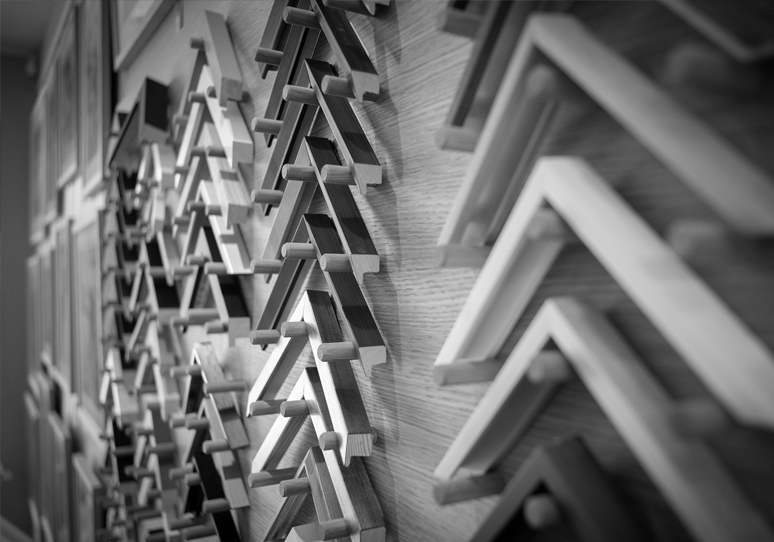
We bespoke frame all prints; this ensures that your print will be presented at its best. Each frame is hand-assembled with joints precisely aligned. The mount is an archival pH neutral museum grade white core mount which does not fade with time. We use 2mm UV filtering glazing and there is a choice of wood and aluminium frames.

