

Evelyn Dunbar
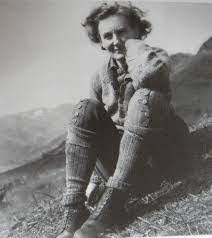
Born in Reading, Berkshire in 1906, Evelyn Dunbar was the youngest child of William and Florence (née Murgatroyd) Dunbar. Her father was a tailor, her mother a gardener and amateur artist. The family moved to Kent when Evelyn was seven. She attended Rochester Grammar School, then Rochester School of Art before further studies, first at the Chelsea School of Art, and then the Royal College, graduating in 1933.
After her studies Dunbar was commissioned to paint a mural at Brockley County Secondary School. She then worked as a book illustrator before opening The Blue Gallery, a large first floor space above a shop run by two of her sisters. She displayed some of her own and her mother’s work and invited other artists too – amongst them Barnett Freedman and Edward Bawden (see artists).
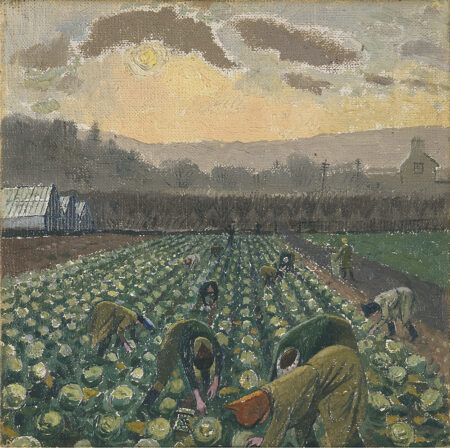
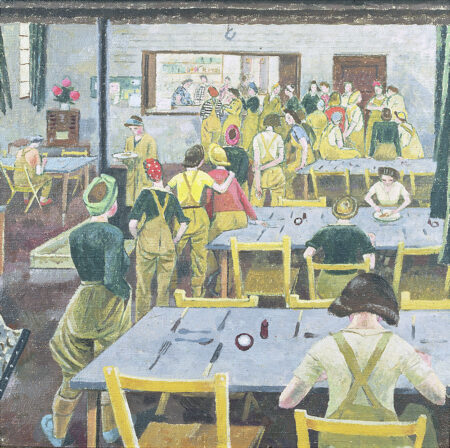
Dunbar was appointed official war artist by Sir Kenneth Clark’s War Artists’ Advisory Committee – the only woman to be so appointed. Her brief was to record contributions by civilians on the home front. She concentrated especially on depicting the work of the Women’s Voluntary Service and the Women’s Land Army, contributing by the end of the war to the Artists’ Advisory Committee 40 or so paintings.
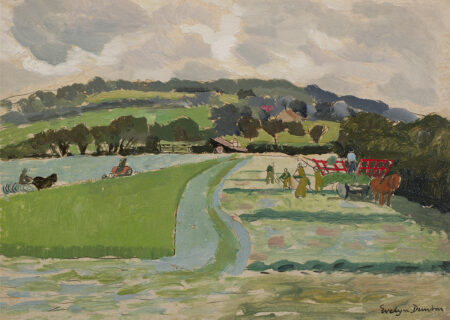
In 1942 Dunbar met and married Roger Folley, an agricultural economist who worked for Sparsholt Farm Institute, Hampshire, as a Costing Officer. The Institute helped train new farmers, and during the war, women farmers especially. Dunbar documented this training as part of her commission (see Study for Haymaking at Sparsholt Farm). After the war the two moved to Long Compton in Warwickshire, where Evelyn set up a studio. She also worked as a part-time teacher at Oxford School of Art and became visiting teacher at the Ruskin School of Drawing and Fine Art, Oxford.
In 1950 Folley was appointed to the Department of Economics at Wye College, Kent, where the couple moved. Evelyn taught classes from their house four miles from Wye, but she also produced portraits of her friends and family, many depicting children, and landscapes depicting the Wealden countryside around her. In 1953 Dunbar held a solo exhibition at Withersdane, the administrative centre situated on the Wye College campus.
On the evening of 12th May, 1960, in the woods near her home, Dunbar succumbed to a heart attack and died. Whilst her oil paintings, especially from the war years, are her main legacy, she left behind portfolios of water colours, drawings and sketches, many of which were never shown. Her legacy suffered somewhat from this lack of exposure, and perhaps too, during her lifetime, from her characteristic self-effacement. Critics had also suggested that her work was insufficiently dramatic, and compared to some of her fellow male war artists this is the case. But her subject matter is not of the dramatic kind, and nowadays there is greater recognition of the place and importance of the work that women did on the home front during the war.
Due to this latter-day recognition, the Dunbar Estate has tried to locate the whereabouts of her work – much of it sold or given to friends and relatives after her death. More recently a tightly bound portfolio, assumed to contain only the work of Evelyn’s mother, was found to contain many works by Evelyn herself. And now, in recognition of the importance of this artist, the ‘lost studio’ works of Dunbar are actively being sought *. This has resulted already in one exhibition at the Pallant House Gallery, 2016: Evelyn Dunbar: The Lost Works.
*Please contact us regarding newly discovered artwork.