

Michael Rothenstein
‘The man himself was gentle, almost childlike……but there was always in Michael an undertow, always a sense that things are not exactly as they appear; there is always some kind of tension, some kind of energy at work, behind what looks still and beautiful and ordinary. And the revelation of what lies behind the ordinary is, in a way, the purpose of his art, and printmaking served that purpose perfectly…….’
Mel Gooding: Talk on Michael Rothenstein, 2019.
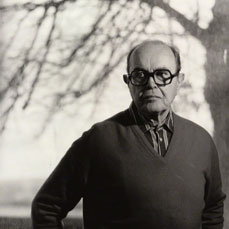
Michael Rothenstein was born in London, 1908, the youngest child of the artist Sir William Rothenstein and his wife, the actress Alice Knewstub. He grew up on a farm in Gloucestershire, in the Cotswolds, and was homeschooled before art studies at Chelsea Polytechnic and then the Central School of Art and Design, London.
Rothenstein is now known and critically acclaimed as a printmaker. But before the sixties he painted watercolours, Neo-Romantic landscapes, and topographical scenes, some of which were used by Sir Kenneth Clarke’s Recording Britain project, which sought to capture life at the home front during the War.
In 1936 Rothenstein married the artist Duffy Ayers and they had two children. The marriage ended in divorce, and Rothenstein would marry Diana Arnold-Forster, but with his first wife Rothenstein would move to Great Bardfield, Essex. Here he joined John Aldridge, Eric Ravilious and Sheila Robinson (see Artists), and during the fifties Rothenstein organised the Great Bardfield Exhibitions. In this he was helped by his brother, Sir John Rothenstein, Director of the Tate Gallery, and they met with huge success, helping to establish many of the artists living there.
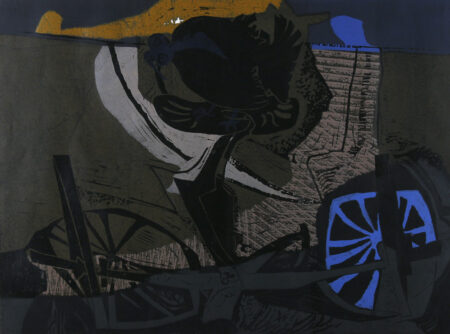
Rothenstein also met Edward Bawden in Great Bardfield (see Artists). Bawden introduced him to the linocut and encouraged the purchase of an Albion Press. Rothenstein would train further, in the fifties, with Stanley William Hayter, at his Atelier 17, in Paris, but through Bawden’s introduction to printmaking he had found his métier. From the sixties on he would practice almost exclusively as printmaker, producing linocuts, etchings, monoprint, relief and intaglio prints, and experimenting extensively with the medium. He would employ the usual techniques, but he also explored directly printing objects onto substrate: he would ink wooden boards, for instance, and press these onto paper, so that the finished print would contain a memory of the texture.
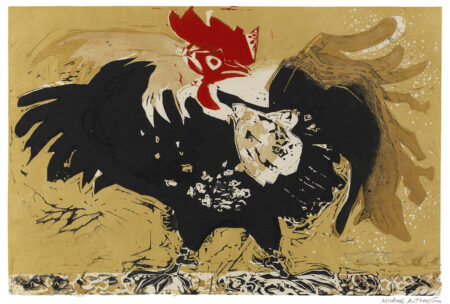
Rothenstein initially flirted with abstraction, but he become representational over time. His subject matter was broad. He responded to the political and social events of the time, but his final and recurring themes were those he first explored as a boy on the farm: interrelations in the natural world, and between humans and the natural world. Perhaps the emblematic image, one that he almost compulsively explored, was that of the cockerel. The cockerel represents many things in his work: raw nature, conquest, confidence, and perhaps triumph over personal pain. When he was a child Rothenstein suffered from myxoedema, or hypothyroidism, a condition which resulted in lethargy and depression, and it is not overly speculative to think that the cockerel, often seen on the farm, with its bright primary colours and exuberant, potent stance, might have worked within the economy of his mind as antithesis to depression.
Rothenstein deid in 1993. He is now recognized as one of Britain’s most innovative printmakers. His work can be found in many public collections: The Tate, London; Victoria and Albert Museum, London; and the Fry Art Gallery, Saffron Walden amongst them.