



Underwood, Leon – Harvest Corn
Price range: £225.00 through £363.00
Description
Colour Linocut. The goddess of the harvest. Painted in the Second-World War during a time in which Underwood was travelling around the country engaged in camouflage work. The white outline, which is found in several of Underwood’s prints, is here reminiscent of the chalk figures found on British Downlands. The print represents both the harvest spirit and the abundance of nature; it also represents the fruits of the artist’s endeavour. As Underwood writes in ‘Art for Heaven’s Sake’ (see Biography): ‘The artist is the sower who casts about him original thought, woven out of his intuition and imagination, and when the conditions are right, germination takes place. The artist is the sower who at the harvest time is over the horizon – on his way to sow new ground’.*
*Art for Heaven’s Sake (1934) p.i; also quoted in ‘Impressions of the 20th Century’, Margaret Timmers, p. 78.
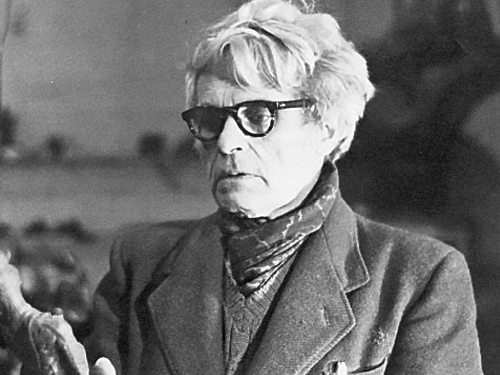
About This Artist
Leon Underwood
Leon George Claude Underwood (1890-1975) worked in several media – as linocutter, painter, etcher, wood-engraver and sculptor; he also taught and wrote extensively on the philosophy and theory of art.
Underwood was born in London, eldest child to Theodore George Black Underwood, a print dealer and numismatist, and his wife Rose Ellen Cornelius who supplemented the family income as a dressmaker. After school Underwood joined his father at their shop in Praed Street, his duties mainly the copying and repairing of prints. In this capacity he first encountered the work of Samuel Palmer and of Blake, and Blake, particularly, was to have a life-long influence on his work.
An exceptionally gifted sketcher, Underwood was awarded a scholarship to the Royal Academy where he studied life-drawing under the tutelage of E.C. Alston, and painting under Gerald Moira (1910-13). As a student he visited Fry’s (1910) Post-Impressionist exhibition at the Grafton Galleries, and whilst he was enthralled by the use of colour, he judged the work neglectful of content. With this assessment Underwood was already positioning himself against the prevailing aesthetic trends: he felt, and would feel increasingly, that a neglect of subject matter was to the detriment of art, and that the embrace of abstraction for its own sake simply led to greater and greater differentiation between art and artists and an ordinary life as lived by the majority.
After a brief time teaching drawing at the Royal Academy (where his pupils included Barbara Hepworth) Underwood moved to what would become his life-long home and studio at 12 Girdler’s Road, off Brook Green, Hammersmith (1919). Here he opened The Brook Green School of Drawing and taught some of the most gifted students of the interwar generation: Henry Moore, Eileen Agar, Blair Hughes-Stanton, and Gertrude Hermes. >From here, too, emerged the Society of Wood Engravers (1925) and also a short-lived review, ‘The Island’, which canvassed some of his own and his students’ art works, and wherein Underwood would publish some of his writings.
Underwood wrote many articles and several books: ‘Animalia’ – a book of verse, and a novel, ‘The Siamese Cat’ – both books illustrated with woodcuts. He also wrote the treatise ‘Art for Heaven’s Sake: Notes on the Philosophy of Art To-Day’ (1934). He travelled widely, visiting Iceland, the cave paintings of Altamira in France, and Aztec and Mayan remains in Mexico; and during these travels he became fascinated with primitive art.
In ‘Art for Heaven’s Sake’ he argues that whilst abstract artists often turn to the primitive for inspiration, they as often miss its essential point: that it communicates to the masses, and does so with so much impact mainly because it avoids abstraction and concentrates instead upon subject matter.
Underwood’s work was exhibited at the Chenil Galleries, Chelsea (1920’s); the Alpine Club Gallery (1924); the Leicester Galleries, London (1934) and a retrospective took place at the Minories, Colchester (1969). He was a member of the Society of Wood Engravers; an Honorary Fellow of the Royal Society of British Sculptors, and in 1961 he received the Jean Masson Medal from the Society of Portrait Sculptors. He died in London (1975). His work is held in major public collections including the Victoria and Albert Museum, London, and the Ashmolean Museum, Oxford.
Related products
-

Bawden, Edward – Brighton Pier
Price range: £135.00 through £247.00 -

Ardizzone, Edward – Tim and Lucy
Price range: £49.00 through £131.00 -

Bawden, Edward – Liverpool Street Station
Price range: £135.00 through £247.00 -

Bawden, Edward – Borough Market
Price range: £148.00 through £260.00 -

Andrews, Sybil – Speedway
Price range: £138.00 through £250.00 -

Bawden, Edward – Cattle Market Braintree
Price range: £148.00 through £260.00 -

Bawden, Edward – Autumn
Price range: £148.00 through £260.00 -

Andrews, Sybil – Racing
Price range: £138.00 through £250.00 -

Andrews, Sybil – Water Jump
Price range: £138.00 through £250.00 -

Andrews, Sybil – Windmill
Price range: £138.00 through £250.00

FRAMING
We bespoke frame all prints; this ensures that your print will be presented at its best. Each frame is hand-assembled with joints precisely aligned. The mount is an archival pH neutral museum grade white core mount which does not fade with time. We use 2mm UV filtering glazing and there is a choice of wood and aluminium frames.

