



Spencer, Stanley – Buttercups in a Meadow
Price range: £215.00 through £363.00
Description
Oil on canvas. There is luxuriance of flower here. Spencer transfixes that peak moment of bloom – things will have changed by the following day. But nodding in verdant approval along the flanks of the meadow are hedges and trees, and a path leads you gently towards a barn, perhaps a house, perched idyllically, as it is, overlooking the sheer abundance in this buttercup meadow.

About This Artist
Stanley Spencer
One of Britain’s most significant painters, Sir Stanley Spencer is celebrated for his garden landscapes, his raw depictions of personal life and his interpretations of biblical narrative – all set in his beloved birthplace, the village of Cookham, Berkshire.
Spencer’s father, William, was a church organist and music teacher. He had his son home schooled from their house ‘Fernlea’, in Cookham, but also sent him for private drawing lessons to local artist Dorothy Bailey. He had further encouragement from a local landowner, Lady Boston. She arranged his attendance at Maidenhead Technical Institute, after which Stanley attended the Slade School of Fine Art, London. Here he was tutored by Henry Tonks, and his contemporaries included Paul Nash and Edward Wadsworth.
During the First World War Spencer served with the Royal Army Medical Corps on ambulance duties. He was sent to Macedonia where he spent two years on the front line, facing German and Bulgarian troops, before being invalided out after experiencing bouts of malaria.
Spencer moved to Hampstead after the War. Here he rented a studio and began work on ‘The Resurrection, Cookham’ (1924-7). This was the first of Spencer’s works to gain critical acclaim. ‘The Resurrection’ is set in the grounds of Cookham church and shows Spencer’s family emerging from graves whilst being watched by the figures of God, Christ, and the saints. It was acclaimed for combining naturalistic detail with the kind of freedom of form associated with newly emerging French art. As the Times’ critic expressed it: ‘It is as if a Pre-Raphaelite had shaken hands with a Cubist’. But Spencer’s use of family and friends in the picture – the juxtaposing of these with the saints, and with biblical themes, would become characteristic of his work.
Spencer married Hilda Carline, a former student at the Slade. They had two daughters and moved to Cookham where they lived at ‘Lindworth’, a large house just off the High Street. But their married life was not a happy one, and Spencer began an infatuation with his model, Patricia Preece. The couple travelled together to paint in Switzerland, and on their return, they found that Hilda, along with their two daughters, had left their house, and was initiating divorce proceedings. After divorce Spencer married Preece. But Preece refused consummation of the marriage and continued to live nearby with her lesbian lover. And gradually Preece took on responsibilities for Spencer’s finances. The house in Cookham was signed over to her, and whilst Spencer was spending time visiting his children back in Hampstead, Preece had the house rented out. This deprived Spencer of a home and a place to work.
At this point Spencer painted a series of nine pictures known as ‘The Domestic Scenes’. In them he recalls with nostalgia his life with Hilda. He sought reconciliation with her, but this was not welcomed, and in any case, Preece would not grant him a divorce. The two – Spencer and Hilda – would nevertheless continue to see each other throughout their lives. Spencer looked after her during her periods of mental instability, over the course of her final days, and before she died of cancer in 1950.
During the Second World War Spencer was enlisted by the WAAC – the War Artists’ Advisory Committee – and sent to Lithgow’s Shipyard on the River Clyde, Glasgow. Here he depicted civilians at work. But the WAAC also gave him funds to rent his former studio back in Cookham – now overseen by Preece – and this enabled a return to his beloved birthplace.
Spencer died of cancer in 1959 , but not before Lord Astor had arranged for him to live again at ‘Fernlea’, his childhood home. Here Spencer remained. To the end he could be seen in his beloved Cookham, pushing a cart containing his easel through the streets as he was wont to do.
Related products
-

Bawden, Edward – Cattle Market Braintree
Price range: £148.00 through £260.00 -
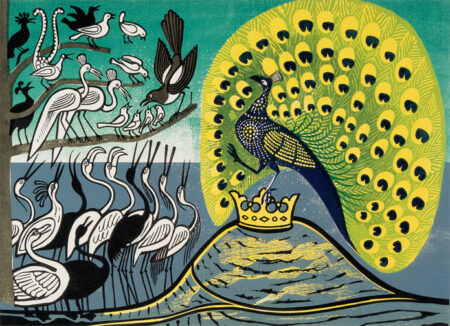
Bawden, Edward – Peacock and Magpie
Price range: £148.00 through £260.00 -

Bawden, Edward – Snowstorm at Brighton
Price range: £148.00 through £260.00 -

Bawden, Edward – A Frog and an Ox
Price range: £148.00 through £260.00 -

Ardizzone, Edward – Bunk-bed at Sea
Price range: £49.00 through £131.00 -

Flight, Claude – Speed
Price range: £138.00 through £250.00 -

Andrews, Sybil – Windmill
Price range: £138.00 through £250.00 -

Ardizzone, Edward – Flotsam and Jetsam (orig. untitled)
Price range: £78.00 through £160.00 -

Andrews, Sybil – Mangolds
Price range: £138.00 through £250.00 -

Bawden, Edward – Brighton Pier
Price range: £135.00 through £247.00

FRAMING
We bespoke frame all prints; this ensures that your print will be presented at its best. Each frame is hand-assembled with joints precisely aligned. The mount is an archival pH neutral museum grade white core mount which does not fade with time. We use 2mm UV filtering glazing and there is a choice of wood and aluminium frames.

