



Bawden, Edward – Tyger! Tyger!
Price range: £135.00 through £247.00
Description
A black and white linocut, 1974, in response to William Blake’s famous ‘The Tiger’: ‘Tiger, tiger, burning bright / In the forests of the night, / What immortal hand or eye / Could frame thy fearful symmetry?’. This is an exceptional evocation of a tiger, and one which perfectly resonates with Blake’s singular vision.

About This Artist
Edward Bawden CBE RA
Edward Bawden [1903-89] studied at the Cambridge School of Art and at the Royal College of Art. He belonged to that circle of friends which included Eric Ravilious, Douglas Bliss and Enid Marx – a group tutored by Paul Nash and famously described by him as representing ‘an outbreak of talent’.
Bawden taught at Goldsmith’s College and the Royal College of Art; at the same time he worked as a graphic designer and illustrator providing posters for London Transport, designs for the Poole Potteries and Curwen Press, and book illustrations for Faber and Faber. During the Second World War Bawden was nominated Official War Artist; he produced mostly watercolours, at this point, and worked both in France and the Middle East.
During the late 1950’s and the 1960’s Bawden produced the linocut and lithographs for which he is perhaps best known. He produced large prints on Kew Gardens and Brighton; on Liverpool Street Station and a series on the London Markets. Clear and bold and often graphic in design – reflective no doubt of his training in the Design School of the Royal College – they are representative of lino-cutting at its best. They also push the creative possibilities of the medium as in, for instance, the angular cuts in Snowstorm at Brighton which make abstract the portrayal of a storm whilst at the same time graphically capturing its impact.
Related products
-

Ardizzone, Edward – Garden at the Red Lion
Price range: £29.00 through £121.00 -

Bawden, Edward – Autumn
Price range: £148.00 through £260.00 -

Bawden, Edward – Hare and Tortoise
Price range: £148.00 through £260.00 -

Andrews, Sybil – Winch
Price range: £138.00 through £250.00 -

Andrews, Sybil – Football
Price range: £138.00 through £250.00 -

Bawden, Edward – The Pagoda at Kew
Price range: £148.00 through £260.00 -

Bawden, Edward – Covent Garden Flower Market
Price range: £148.00 through £260.00 -

Andrews, Sybil – Windmill
Price range: £138.00 through £250.00 -
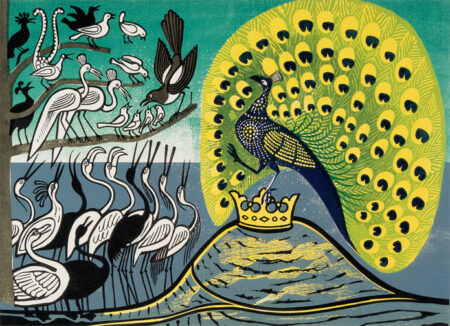
Bawden, Edward – Peacock and Magpie
Price range: £148.00 through £260.00 -

Ardizzone, Edward – Domino Players
Price range: £29.00 through £121.00

FRAMING
We bespoke frame all prints; this ensures that your print will be presented at its best. Each frame is hand-assembled with joints precisely aligned. The mount is an archival pH neutral museum grade white core mount which does not fade with time. We use 2mm UV filtering glazing and there is a choice of wood and aluminium frames.

