



Armstrong, John – Royal Mail AD 1935
Price range: £115.00 through £227.00
Description
Sir Stephen Tallents, Public Relations Officer of the Royal Post Office in the 1930’s, commissioned several artists to create sets of educational posters to be used in schools for the purposes of raising the profile of the Post Office. Themes included ‘Outposts of the Britain’; ‘Outposts of the Empire’ and promotion of the General Post Office workforce, and were explored by, respectively, Edward McKnight Kauffer; John Vickery and Duncan Grant.
Armstrong was invited to work on a series depicting the history of communications. As his interests stretched through historical time the first in his series depicts Pheidippides – the herald who ran from the Battle of Marathon to Athens to proclaim victory over Persia in 490 BC; the second is entitled ‘King’s Messenger AD 1482’; the third ‘Mail Coach AD 1784’, and the forth, which we publish here, ‘Royal Mail’ as delivered in 1935. With its flat background and semi-abstract forms so consistent with 1930’s art tendencies of the time, this is an exceptionally strong rendering of mid 1930’s iconography.

About This Artist
John Armstrong
John Armstrong was born in Hastings, Sussex, the third son of a Parson, the Rev. William Alexander Armstrong. As an artist he is difficult to pigeonhole: besides painting, he was a prolific designer for the theatre and film industries. He also produced memorable work for the General Post Office; for Imperial Chemical Industries, and he designed a series of distinctive posters for Shell.
A few years after his birth the family moved to West Dean in the Sussex countryside. After schooling in Sussex Armstrong left his family to study law at St. John’s College, Oxford (1912-13), and he then attended St. John’s Wood School of Art (1913-14). During the war Armstrong became an officer in the Royal Field Artillery, and after the war he took what jobs he could – decorating lampshades for Heals; helping with theatre scenery and costume design; and he also executed murals. One such was for Lillian Courtauld, the wife of Samuel Courtauld, who invited him to decorate their home at 20 Portman Square, now the Courthauld Institute of Art.
In 1928 Armstrong had his first one-man show at the Leicester Galleries. The Times’ critic, detecting an unwanted influence of ‘theatrical design’, judged his paintings insufficiently realist. But whilst Armstrong was interested in incorporating figures and objects from the visible world into his paintings, he did not want to attempt a realist portrayal: ‘As a child’ Armstrong wrote, ‘I loved everything painted because it was painted and not real’. And this tendency towards the unreal, or surreal, he began to develop further.
Work in his second exhibition at the Leicester Galleries in the following year clearly evidences the influence of de Chirico – the painter who perhaps had most influence on Surrealist tendencies in British painting at the time.
In 1933 Armstrong helped Paul Nash (see artists) found Unit One. The seminal currents in modern British art of the 1930’s were abstract art, on the one hand, and Surrealism on the other. Unit One attempted to embrace the full spectrum, with Nash himself making both abstract and Surrealist work (see Nash – Biography). The first and only exhibition of the group was held at the Mayor Gallery in 1934. It was accompanied by a book, Unit One: the Modern Movement in English Architecture, Painting and Sculpture which largely consisted of statements or answers, illustrated by work, to a series of questions posed by the critic Herbert Read. Armstrong managed to avoid answering questions on theory, technique and policy, but he argues for freedom of choice in expression – clearly he still felt the wish to be unfettered by an expectation from the art world that he concentrate solely on easel painting.
Armstrong’s plea for ‘freedom of expression’ was in part the result of a need to pay his way. His paintings did sell, but most of his income in the 1930’s came from work designing costumes for films produced by Alexander Korda – e.g. ‘The Private Life of Henry V111’, 1933, and ‘Rembrandt’, 1936.
At the end of the decade and beginning of the Second World War Armstrong was made an Official War Artist. He moved from London to Essex, near Dunmow – not too far from Great Bardfield where Ravilious and Bawden (see Artists) were residing. One of his first paintings commissioned by the War Artists’ Advisory Committee was a painting of a bombed church tower at Coggeshall, Essex, in 1940. His subsequent work included ‘Burnt Out Airplane’ (1941) and ‘Making Templates for Gliders'(1942).
After the war Armstrong returned to painting. Stylistically the direction he adopted tended yet further towards the surreal. He focused on content from diverse and wide areas of interests: from Greek mythology and Christianity, to peace and the non-proliferation of nuclear weaponry. In the early 1960’s Armstrong’s health deteriorated, and he eventually died of Parkinson’s disease in 1973. Armstrong was elected Associate Member of the Royal Academy in 1966, and he left a body of work, wide in scope and increasingly critically acclaimed. In 1975 there was a major retrospective of his works held at the Academy, and his paintings can be found in collections of the Tate, London; the V & A, London; Manchester City of Art Galleries and the National Gallery of Wales.
Related products
-

Bawden, Edward – Hare and Tortoise
Price range: £148.00 through £260.00 -

Andrews, Sybil – Water Jump
Price range: £138.00 through £250.00 -

Bawden, Edward – Snowstorm at Brighton
Price range: £148.00 through £260.00 -

Ardizzone, Edward – Domino Players
Price range: £29.00 through £121.00 -

Bawden, Edward – Covent Garden Flower Market
Price range: £148.00 through £260.00 -
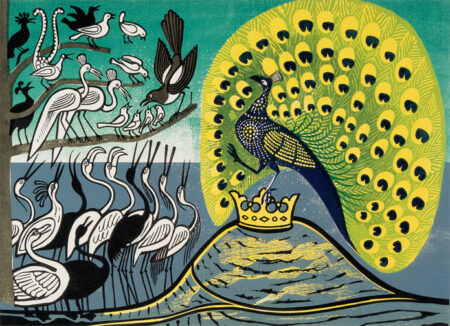
Bawden, Edward – Peacock and Magpie
Price range: £148.00 through £260.00 -

Ardizzone, Edward – Barmaids Old and New
Price range: £29.00 through £121.00 -

Bawden, Edward – The Pagoda at Kew
Price range: £148.00 through £260.00 -

Ardizzone, Edward – Bunk-bed at Sea
Price range: £49.00 through £131.00 -

Bawden, Edward – Cattle Market Braintree
Price range: £148.00 through £260.00

FRAMING
We bespoke frame all prints; this ensures that your print will be presented at its best. Each frame is hand-assembled with joints precisely aligned. The mount is an archival pH neutral museum grade white core mount which does not fade with time. We use 2mm UV filtering glazing and there is a choice of wood and aluminium frames.

